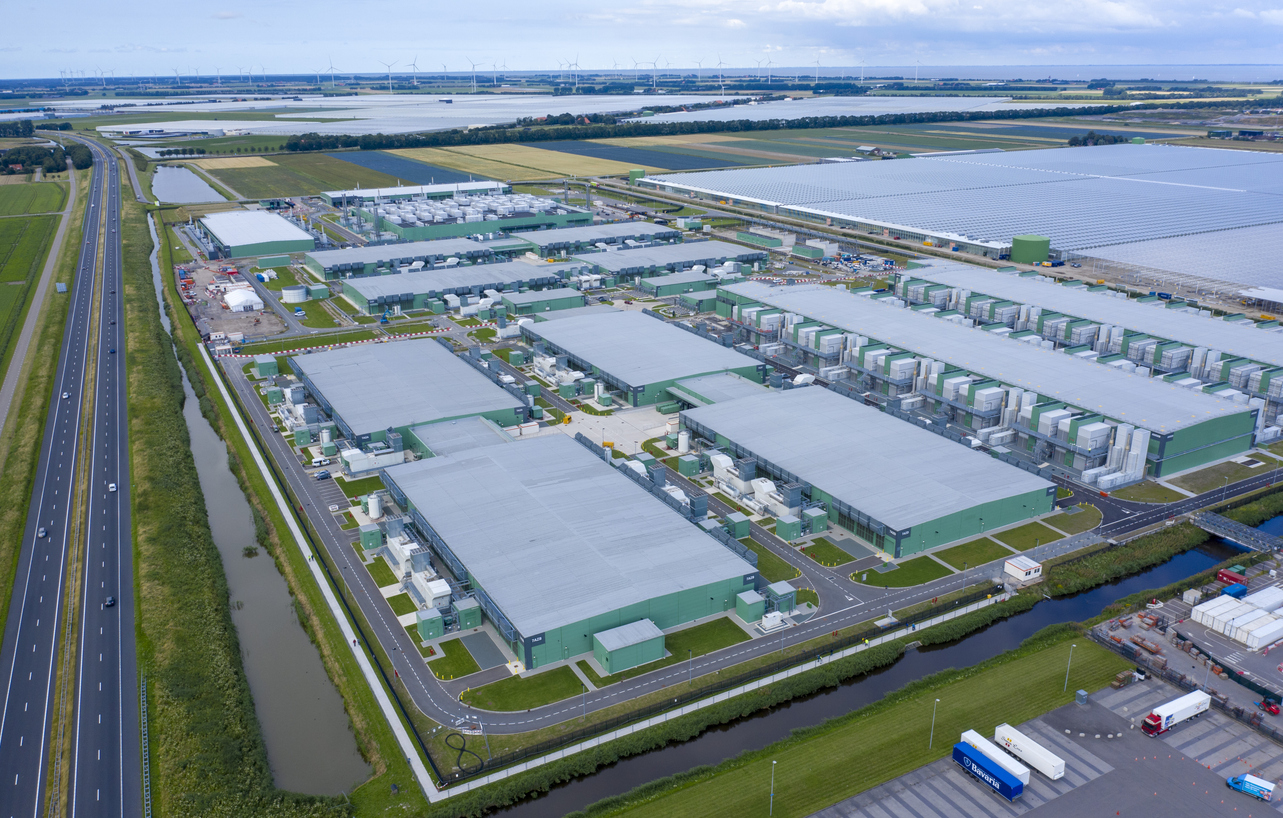
The sustained growth of data centres (DCs) as an asset class is a prevailing trend following increased demand for low-latency internet access and AI development capabilities across global markets. Innovation across DC configuration designs have been taking place alongside this growth to make gains in operational efficiencies as AI workload intensity is continually increasing power demands in these assets. This ramp-up in investment activity poses simultaneous challenges to both national infrastructure developers and DC operators as breakneck demand for electricity grid expansion extends wait-times for grid connection- demand and supply to the grid both joining the same connection queue- with connection times in Virginia, USA now reaching 7 years.
Grids are being improved on to ease transmission bottlenecks and enable market entry for gridtech assets that form part of national plans to increase and diversify electricity loads. Data centre operators are at a crossroads in this climate as achieving permission for grid connection with such a power-hungry asset behind-the-meter is a multi-year wait, even where the grid surrounding a given DC location is not the most constrained. In the USA where permitting for DC developments has recently been effectively streamlined through the AI Action Plan, the need to ensure effective value for money is a primary concern and so improving energy efficiencies remains central in this context.
This makes it important for both the planning and the operational side of the DC industry to economise power demand with innovative energy solutions so that more streamlined grid connection proposals can improve development timescales while power consumption adaptations compound those savings across the DC operational phase. This is especially important for DC operators with some site flexibility who are rightly considering secure power sources to replace year-round diesel backup generator use with a solution that saves on OPEX while being easier to source than hydrotreated vegetable oil or biodiesel.
Scale of demand
The total electricity demand of DCs across the world in 2024 equated to 415 TWh, more than the power consumption of France in that year. Yet, by 2030 this figure will likely be reached by Chinese DCs alone, with global DC electricity demand growth pushing 945 TWh, according to the IEA’s base case analysis. While the power efficiency of AI models has increased drastically over the past few years, the increasing integration of AI into digital life will continue to drive electricity use upward and provoke shifts in power infrastructure use.
This scale of demand is of course an issue in itself. An added aspect to this is the energy usage characteristics of DCs being relatively stable. Internet servers run 24/7 and DC electricity demand reflects this predictability to some extent. Acquiring cheap PPAs to fulfil this requirement through retail suppliers is not feasible where premiums of at least 13% do not get offset by increased security of supply within a medium-scale DC setup. Long grid connection timelines may defeat the advantages of gaining a high capacity connection, while development restrictions across the low latency, fibre optic-enabled locations that DCs prefer mean that workable solutions for managing power demand are much needed and yet also potentially cumbersome having been put in place, unless evaluated carefully beforehand.
Hedging across forward power markets is another option for reducing power prices but in order to effectively decouple an asset from market fluctuations and the transmission and distribution network rents that can make up 50% of an electricity bill, the best way to save on the 30-60% of overall DC operating costs that electricity represents is to integrate behind-the-meter generation with operational optimisations, allowing for efficient use of electricity alongside power generation capabilities that together can create a highly energy-independent DC with relatively low operating costs- without grid connection delays.
Varieties of on-site energy solutions
The on-site energy solution investment strategy can lead to massive savings for DC investors prepared to instal such high CAPEX projects. Such integrations are a key enabler of DC scalability. In fact, nearly 50% of data centres are expected to adopt on-site power generation by 2035.
Battery storage is a mature option even if it is a highly scale-reliant solution having noticeably more potential for larger DCs- Vertiv’s battery cabinet offering can provide start-up power security for smaller-scale units though. Such units would shave peak demand without providing power for more than 30 minutes. With electricity tariffs often incorporating peak demand levels of a grid connection for any half-hour period where the grid is most in-demand, having a shorter-term but higher KW power transfer capacity can be more effective than investing in a larger, longer-term reserve asset. This is because the ability to shave small reductions in the most power-intense periods can have an outsize effect on yearly outgoings.
Elsewhere, on-site power generation through hydrogen fuel cells provided by the likes of Bloom Energy are gaining ground in this segment as H2 feedstock availability increases. Reductions in operational costs are also possible where DCs’ main power supply can be harnessed from H2 fuel cells as the overbuild requirement is less than that for reciprocating engines due to fuel cells’ better energy conversion efficiency.
One of the most flexible solutions, however, hails from organisations such as Landmark Power Holdings with their combined heat and power integration of gas engine electricity generation with further power supply taken from the engine’s waste heat through an organic Rankine cycle unit. These two cycles are complemented with a carbon capture installation taking care of exhaust and allowing for utilisation through partnerships with industry CO2offtakers. This is a more viable alternative to hydrogen fuel cells where the transportation infrastructure and local market for hydrogen is less developed.
The options mentioned are locationally dependent as installation of sizable behind-the-meter units can require a lot of space and planning approval which may not be possible on pre-existing sites. This is not as much of an issue with the new generation of AI data centres as these do not require the low latency, urban centrality of many conventional DC sites that need to be close to banks, for instance. The advantages of being able to integrate on-site power generation with storage moves the needle for DC configurations, so where possible this is the best way to outflank connection delays and high electricity prices.
When it comes to not only operating DC assets with local power but also, and potentially more importantly, increasing the energy efficiency of the asset’s power usage, the most obviously leverageable optimisation to drastically reduce power requirements relates to the cooling mechanism installed for keeping DC server racks functioning. Options for server cooling optimisation represent a flexible proposition for both fresh and retrofit DC installations.
Power-saving with DC cooling
Through 2024, DC server rack power requirements averaged at around 20kW each but that is expected to more than double going into 2027. Servers get replaced around every 4 years, with hyperscale sites known to save costs by extending rack life by a further 2 years. With increasing power densities, server operation costs run up not only for meeting processor requirements but also for the significant demands of cooling server racks.
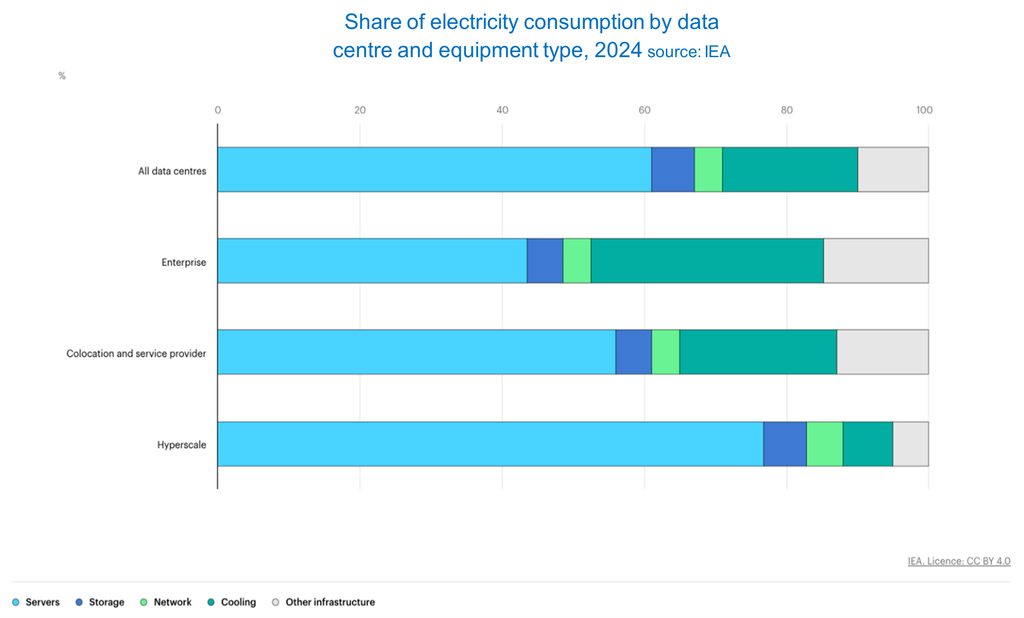
Server cooling can require up to 40% of a DC’s power usage depending on energy efficiency configurations. While server power efficiencies are the main drag on DC electricity consumption, this is improved mainly through GPU innovation. Cooling methods for servers by contrast have a good range of low- to high-capex solutions that can be implemented across different types of DC.
With energy efficiency measures increasingly making their way into policy plans, there is a clear motive to align DC configurations with futureproofing requirements. Legislation in Germany, currently the second largest DC market jurisdiction globally, as well as with the EU’s very own DC energy efficiency package being released in early 2026, are both cases in point- the former policy implements requirements for >300kW DCs to reuse incrementally larger portions of their waste heat from 2026, starting at 10%.
In utilising this waste heat there are opportunities for DCs to economise their operations as an organic Rankine cycle can convert up to 70% of this to electricity, with conversion rates from liquid water being higher than those with hot air flow. While this electricity could be fed straight back into DC power inputs, there is even more flexibility open to DCs looking to reduce cooling costs while being able to incorporate long-term energy storage into their sites. This is especially the case where more intense power demands of AI-oriented DCs can produce waste heat up to 75°C- utilisable for waste heat conversions like organic Rankine cycle.
Underground thermal energy storage (UTES) can also allow for the utilisation of this waste heat and in combination with day-ahead market optimisation can provide a 16.8% cost saving on electricity used across DC operations by reducing electricity usage for cooling by 40-70%. This technique helps to improve DC power usage effectiveness (PUE) scores. With DCs running at an average PUE of 1.55 in 2022 and regulatory reform on the horizon, efficiency building measures such as these will be required. Using the German regulation as a guideline, a PUE level of 1.2 will be required for DCs coming into operation there from July 2026.
The low resource input of UTES energy generation makes it valuable in this context as up to 100% of this input can be retrieved freely from ground temperatures, as in Equinix’s AM3 DC which has an impressive PUE score of 1.19. Additional construction of aquifer-TES DCs in this region is underway with Digital Realty’s AMS7 project. The unique benefit of UTES is its seasonal scope as opposed to daily scope with other storage technologies. Flexible demand can achieve off-peak prices where wind/solar curtailment would otherwise occur and more rural DCs with higher PUE scores can make use of more space and planning flexibility by integrating UTES into its DC architecture. Combined with optimised liquid server cooling management systems and configured with market prices, servers are cooled with UTES electricity at peak price points, with grid power used during only the most economical annual periods.
Conclusion
There is no one-size-fits-all solution to DC energy challenges. Thermal storage installations can be particularly cumbersome in more populated areas where DCs are closer to work and home environments, making quieter solutions like fuel cells potentially more attractive. Units that utilise waste heat and optimise their cooling practices can reap the benefits of high energy efficiency. As the number and scale of DCs increases worldwide, tackling the issues related to energy usage is a priority for sustaining growth and maintaining standards across the industry. Here we’ve delved into some of the main aspects to watch over the coming years.