Offshore wind: current trends
Offshore wind is reaching a global construction boom point as global markets are generally providing more encouragement and attention toward the development potential that largescale offshore wind farms offer from an energy pricing perspective. States with large wind power potential have made improvements to their permitting and market structure regulations recently, with Germany building on the 15GW of onshore wind permitted in 2024 by forcing planning permit appeal cases to now consider binding requirements to expand national wind and solar installation alongside the pre-existing legal priority given to non-infrastructural issues like biodiversity loss. This reform signals increasing maturity across this major European market and should mean that major industry players like RWE and Siemens can move forward from planning to rollout major projects across the German grid as well as across other European systems.
Developments in the Chinese wind regime over the past 2 years support the trend seen in European countries like the UK and Germany. In China, local government PPA offtake mandates for 100% of wind project output have been replaced to some extent with merchant risk through the implementation of the Guaranteed Purchase Measures, which introduce market trading for wind operators. With 171GW of wind projects currently under construction in China and 444GW already operating, the time for this industry to be moving into a new stage of maturity has without doubt arrived. This increase in domestic risk faced by globally competitive Chinese developers like Goldwind and Ming Yang may trigger increased market activity across western and developing power sectors as these firms look to favourable outward opportunities to maintain exposure across global markets.
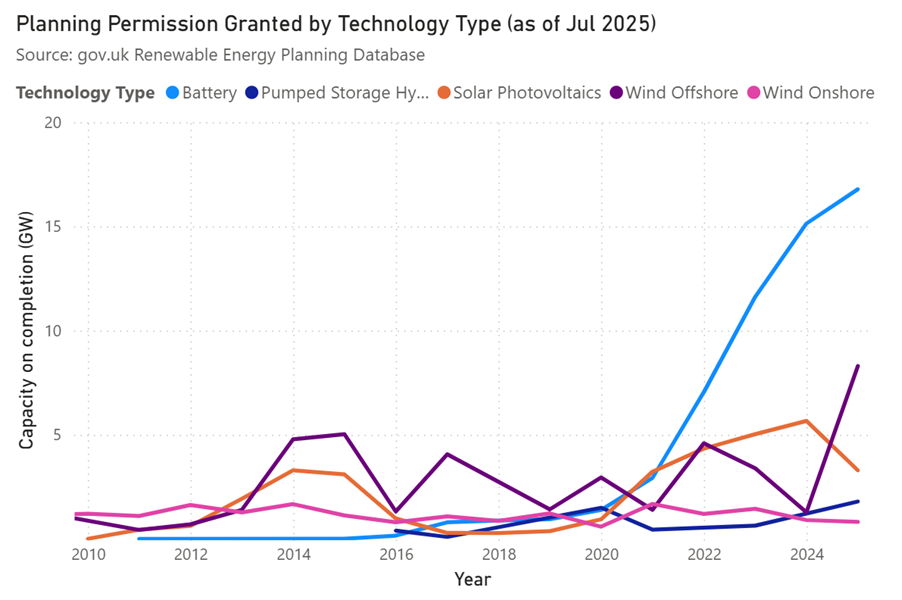
Auctions are the main strategy that governments use for deploying cost effective wind generation capacity, and auctions have seen substantial changes in 2025. Germany followed in the footsteps of Britain’s 2023 AR5 failure by hosting an auction that failed to attract any bids, while the Labour government in the UK tinkered with previous auction rules to relax allowances for planning progression required of offshore wind projects. This has been accompanied by an influx of investment in pre-construction planning from the wind industry. These developments have been occurring alongside a decline in wind developer market confidence as projects such as those of Ørsted and Equinor were withdrawn due to price rises and supply-chain issues. The following chart shows UK renewable energy project planning approval rates having risen dramatically. In order to ensure that developers actually go on to build and operate these assets, though, a good look at the auction process and what parts of a project bid it prioritises, is needed to ensure that largescale projects are consistently seen through to completion.
Competition and cancellation
The existence of increasing global competition in the wind sector means that to acquire development contracts in any jurisdiction for a certain level of generation capacity there is a race to achieve high technical standards. This has resulted in ever-larger turbines being developed to generate more electricity from fewer assets so that cost of energy for consumers is reduced. The downside to this is that rapid introduction of new design iterations slows down manufacturing and installation as the learning curve for new projects is constantly changing – wind turbines are typically composed of 80% new parts with each iteration, whereas for cars, a more industrialised product, this figure is halved. Added to this is the lack of standardisation across global markets – think regulation and weather – making these projects particularly tough to stay on top of.
National markets for wind projects across the world have tended to converge around auctions as the main strategy for delivering capacity. The Contracts for Difference mechanism as a long-term fixed-price contract auction can be seen as typical- the predictability of the strike price agreed in advance can give a solid footing for developing largescale projects and working out cash flow requirements across the different power markets that the asset would be participating in. Yet the trouble with this is that where a large portion of the power generation potential is tied up in a CfD it means that there is less room to regain funds that may have been lost in unpredicted ways such as financing and component cost rises. This is why projects tied up with CfDs to enable largescale windfarm development may find themselves to be unviable in worsening economic conditions. For this reason there is a case to be made for reassessing project bids so that successful bidders have a combination of qualities that make them a secure partner while also allowing for a secure project revenue.
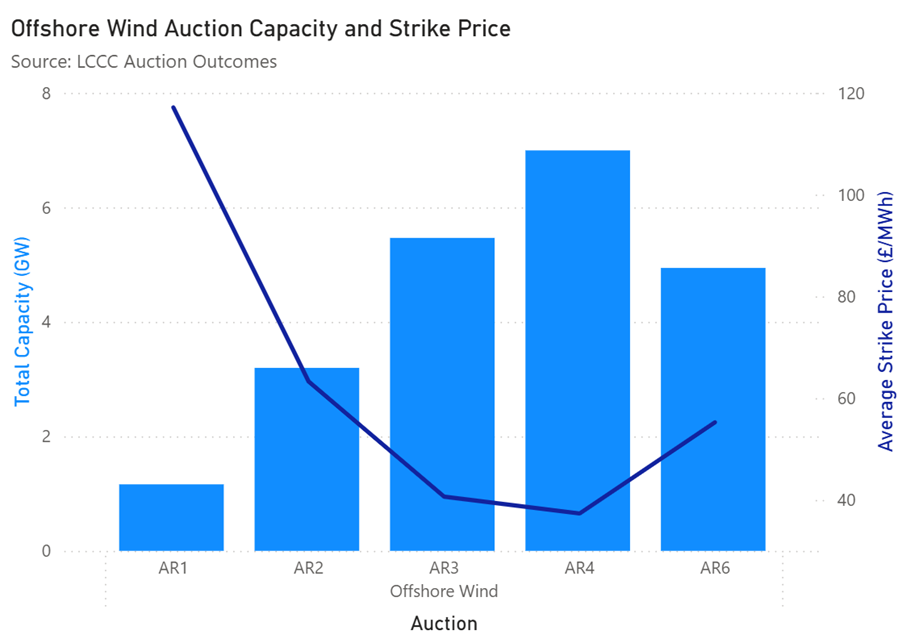
If we look at the UK’s 2024’s AR6 offshore wind strike price you can see that it rises to just under £60/MWh from under £40 reached in 2021/22’s AR4. As a wholesale cost this usually represents around 35% of a final electricity bill. When converted into KWh measure the £60 figure makes up £6/KWh of an energy bill, which would then likely come out at a total of under £20/KWh for the final customer.
Lead-times after auctions being 3-5 years before delivery can be either a good or a bad thing depending on the specific circumstances in the market at a point in time- for instance the German auctions of 2017/18 competing for one-sided CfDs (essentially a subsidy during periods of low-price power trading) capitalised on their pre-development period by innovating toward lower costs. This has not been the case for the potentially terminal delay of Ørsted’s Hornsea 4 wind farm off the coast of North-East England, as well as Vattenfall’s sale of its Norfolk Boreas wind farm to RWE.
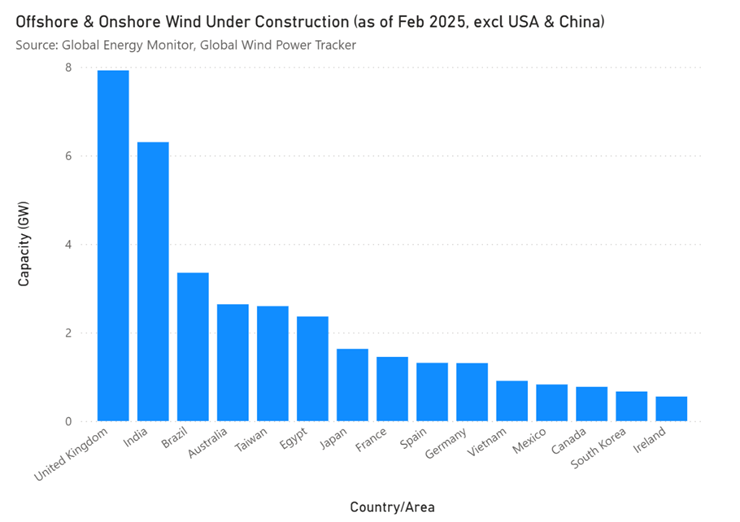
With the acceleration of Chinese turbine manufacturers there is an opening up of opportunities as well as risk to the global market. This is reflected in developing nations like India and Brazil’s high power growth trajectories providing the conditions for wind turbine OEMs to expand their operations. This stage of maturity in the wind market is a unique historical situation as far as the power sector is concerned because the technical proficiency required to stay on the cutting edge of this industry is unlike previous largescale generation technologies which had predictable feedstock and construction requirements. In what was a traditionally oligopolistic industry there is now a variety of competitors that are planning and operating unsubsidised assets secured with primary offtake on auction terms.
So, with power prices reduced to price parity levels (and below) in the offshore wind industry, the question to ask is whether there should be a continuation of the auction process in its current guise, or whether there should be non-financial conditions prioritised across bidding formats for offshore wind projects. This latter solution may enable the resolution of supply-chain issues as a means to maintaining low prices through a strategy that priorities industrialisation and standardisation over innovation.
Changes to auction conditions
Auctions have been successful in bringing electricity prices down but the factors outlined above inhibit value and implementation improvements for project formulas that can achieve not only low prices but also highly consistent success. The reason for this being an issue is because of the increase in projects not making it to final investment decision stage as a result of supply-chain and interest rate difficulties. The negative impact of these trends can be lessened, in the process benefitting customers by ensuring that cheap power comes online as quickly as possible. For this to happen, adjustments would need to be made to the existing bidding process of major auctions.
Such policy changes are already starting to come about, with China having held auctions that assign values to various non-financial measures such as ‘investment capabilities’ and ‘technical capabilities’. While seemingly allowing for reduced price competition by placing emphasis on process improvements, the result is that including such considerations can lay a more secure engineering and industrial foundation for lower prices on a larger scale. These advances have already been picked up on by the EU in its legislation for establishing non-price criteria in wind auctions. Across Germany and the Netherlands there have been separate sets of auctions that show the reduction in bid price from developers as a result of having non-price criteria used as a tool for selecting successful projects.
Moving in this direction would have the benefit of allowing for a more open-book process than currently exists in a CfD auction system where little transparency between government and developers exists after the bid has been accepted. Such issues have been highlighted with the UK system, but unlike other solutions such as a regulated asset base model, sticking with the overall CfD framework would keep costs in private hands.