With the REMA decisions approaching this summer there is a good opportunity now to analyse how best the energy market might be altered in order to bring prices down in the medium to long run. There are two main arenas in which policy can have a large impact- wholesale markets and the balancing mechanism. These two markets influence each other because locational grid constraints are priced a certain way as a result of national pricing on the wholesale market clearing price, while the smaller, pay-as-bid balancing mechanism allows operators to correct these constraints and therefore make money from them. Certain locations can be more valuable for assets that provide flexibility to the balancing market and these same assets may optimise their production by participating in the wholesale market as well. This market environment creates the playing field for operators to wager in which markets their generating capacity is best provided in order to achieve the best rate of return. Generating capacity is often withheld in order to achieve a better return on the balancing market, once locational constraints come into play and the system operator then seeks more MWh from specific locations.
Locational market signals and constraint costs
The obvious approach to reducing system constraint costs, proposed across the industry, relates to the increased incorporation of locational signals into system trading patterns. The reason why this has received so much attention is because of its relevance to infrastructural cost constraints that can be minimised in delivering power under such an approach. The proposition of increasing locational market signals will be assessed before a better option for decreasing outright constraint costs is proposed through a new iteration of an old model (regulated asset base) for peaking gas plants. This model has the potential to filter decreased balancing costs through to wholesale and forward markets while retaining flexibility, as long as this can be made viable to enough CCGT operators so that such a change can be effectively implemented as an end-of-life, out-of-market scheme for these assets.
Locational market signals work by bringing market price more closely into line with system needs by pricing grid congestion on locational constraints for a specific point or zone of power generation as opposed to imposing vaguer yearly banded levies on operators. One of the more major costs that it is argued would be reduced through such a change is that which relates to the balancing mechanism used to redispatch generation across Britain as a result of transmission constraints not being pre-integrated into the wholesale market platform. The balancing mechanism serves to match supply to demand exactly by:
1) hosting offers to increase supply to underserved areas (reflected for end-consumers in higher electricity tariffs where smart meters are in use), and
2) hosting bids to reduce supply where congestion is too high (reflected in lower electricity tariffs for end-consumers where smart meters are in use).
Where balancing costs for 2024 were just under £2.5bn, the trend has involved a gradual rise when discounting the huge increases seen during the 2021-2023 energy crisis period, with yearly costs since 2020 representing a near-doubling from £1.4bn. NESO predicts that they may triple again before beginning to decline around 2030- depending on the effectiveness of policy used to tackle grid constraint costs.
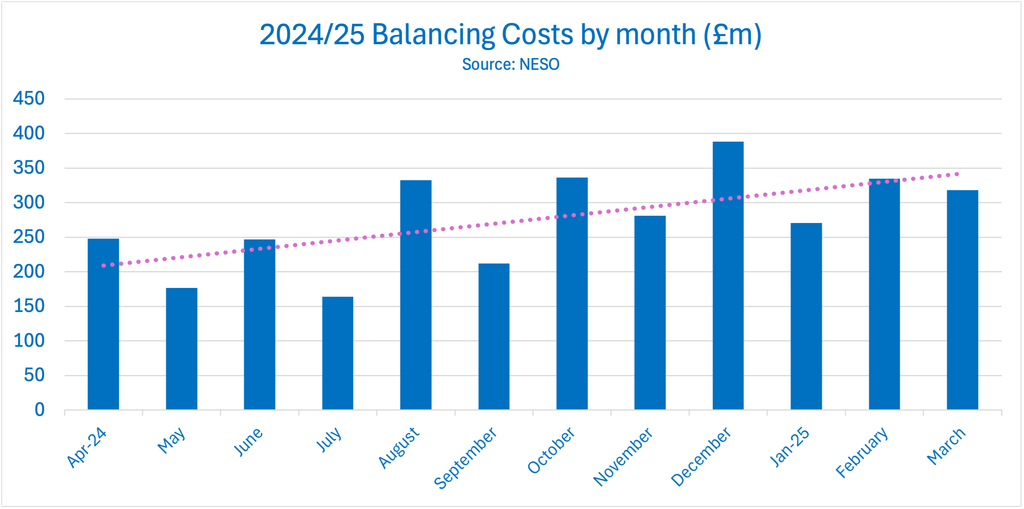
The reasons for increasing balancing costs are due to locational constraints from grid congestion, combined with the unpredictability of a large proportion of GB baseload power generation. This combines with high variable cost gas generation being the most widely utilised quick-dispatch balancing tool (in contrast to low-cost pumped hydropower or battery energy storage systems), to create a souring cocktail of policy and investment decisions as increasing constraint costs will march sidestep with the implementation of the government’s Clean Power 2030 ambition. The main solutions to this problem are:
1) investing in grid infrastructure to increase potential power flow volumes across transmission and distribution networks (reducing congestion rents),
2) investing in cheap, flexible power assets to reduce offer prices in the balancing market- e.g. batteries, demand-side response (solar/vehicle-to-grid), and hydrogen generation/storage, alongside other pilot technologies,
3) altering market conditions to better enable cost savings by increasing locational signals for marginal gains and/or creating new gas operator obligations.
This list is of course not extensive but it hits on the main topics that are open to discussion at the minute. The necessity of investment across networks and technology uptake is a given. The market platforms on which power is traded are another, riskier game as they impact investor confidence to provide capital to the required investments. GB wholesale market platforms do not explicitly take into account locational differences and this means that there are inefficiencies but it creates a level market playing field across the national system, creating a more open field for investment to consider. Imagine the cost differences of buying land for power generation in the most congested southern regions of British electricity demand, in comparison to where abundant natural energy resources reduce congestion tenfold. Changing the market with locational signals also puts significant pressure on the investment models used for existing generation units which were developed on the basis of a particular regulatory system. Increased returns on future investments (and therefore higher electricity prices) would be required to balance investors’ books, let alone balance the GB power market which would potentially suffer under such a change.
In practice an approach spurred more by locational congestion, when moving from a national pricing system, is not only economically sensitive, but politically sensitive too, as it means that those living in more congested zones will end up paying more for electricity than those who are not. Of course this is something that certain market actors can capitalise on, especially those with a great deal of expertise trading in these markets and those who operate flexible energy resources such as battery energy storage systems. While the locational efficiency of zonal can be a plus, there is a case to be made that the incentive to develop energy resources on these (somewhat) arbitrary zonal borders would create a slightly skewed setting that has led to disquiet among other implementers of zonal pricing such as Norway and Sweden.
So might there be a more effective way to reduce costs to customers while minimising negative impacts on Britain’s Clean Power 2030 target? Here we argue that while there are advantages to be gained from changing to a zonal system which better incorporates locational signals, the more economically risk-averse and targeted reform would be to focus on restructuring the boundaries of market participation that current flexible balancing mechanism dispatch units are provided.
Gas and the out-of-market solution
Having established the risks involved in moving from a national to a locational market pricing system, we should contextualise constraint costs within the totality of balancing market cost-drivers. Load-serving entities within the balancing market correct constraints for a cost. Those constraint costs are being reduced through major investment going into transmission and distribution, especially with the rollout of smart meters and distributed generation. With these improvements that admittedly will be realised around 2030, the real present gains to be made relate more to wholesale energy costs than seeking to more accurately price constraints through locational market signals.
The majority of balancing payments for power supply are made to gas turbines (OCGT/CCGTs) as these are the most widely available dispatchable units that exist in the congested southern region of England. This makes them the most able technology to provide generation capacity during periods of system stress, having provided 10,000 GWh on average to the balancing market in each of the last three years- enough to power 1-2 million homes for an entire year, so a highly significant amount of power.
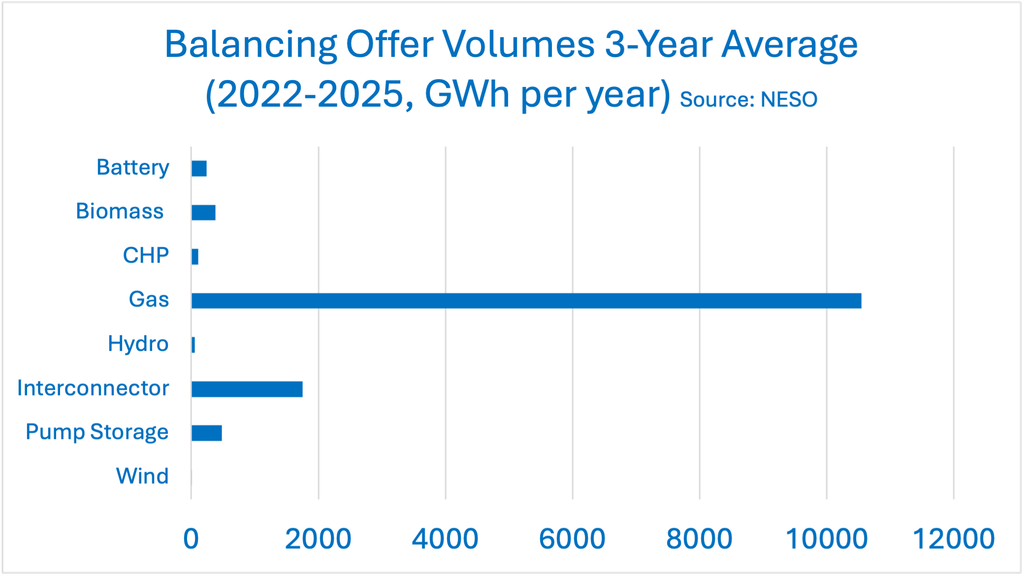
A package of reform that would represent a better option than shifting the wholesale market structure would be to separate gas from this market as many gas plants are nearing their end-of-life and due to their high variable price of fuel, they require significant payments for their balancing services.
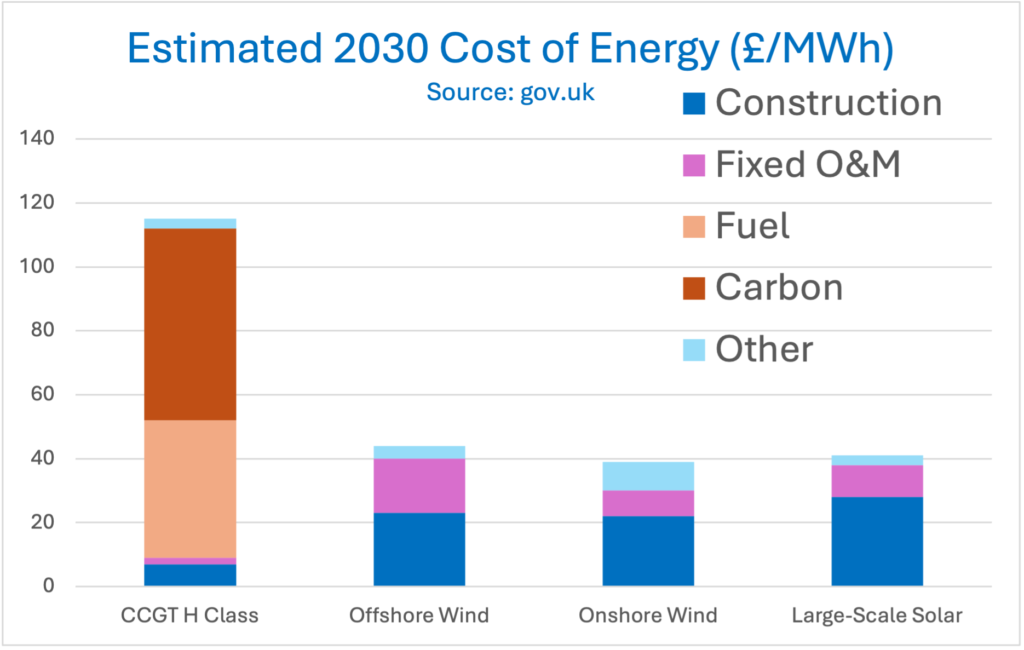
The overall cost of generation for gas turbines has been shown to be significantly higher than comparable renewable generation, even when not taking into account green levies (shown as carbon costs). The relative cost differences between the different technologies shown below for 2030 are very similar to those that exist currently. Gas turbine market operators are yet more able to game the balancing needs of the system compared to other load-serving entities. A shift in approach to using CCGTs for balancing services is needed. To do so effectively and meet system needs at cheaper price points, it would be sensible to remove CCGTs from participating in this market on
a pay-as-bid basis.
This would allow for a regularisation of payments made to these units so that system needs could be met at predictable levels. This would reduce the volatility of the balancing market by ensuring that such “peaking” plants are operating around their cost-of-service price points. While attractive, it is not immediately obvious how this helps to reduce prices more generally as the fuel prices for gas would still need to be paid for. The reduction in price comes through the markets that gas is taken from as opposed to reducing the price of CCGT generation as a balancing unit itself.
This out-of-market step would essentially work like a contract for difference except it would only operate through central dispatch by NESO according to system needs, as opposed to the forward and day-ahead wholesale market participation of CfDs for wind generation. Its out-of-market nature would enable it to complement in-market operating units while being controlled through a central dispatch mechanism that pays plants on a regulated asset base (RAB) rate that reflects service costs + a reasonable return. This resembles previous iterations of electricity markets and requires auditing of business processes so that efficiency gains are actually made rather than taxpayers losing out through excess rents being collected by operators who see the cost-of-service function as an opportunity to gold-plate their business processes.
The benefit that this has is that it would remove gas turbines from spiking not only balancing market prices but wholesale market clearing prices too. This spiking occurs as the market clearing model ensures that electricity demand is met in a cascading fashion up until the final, implicitly most expensive unit of electricity is matched to the marginal generation unit for each half-hourly time unit, triggering a clearing price commonly paid by every actor bidding for electricity across the system for that time. As strategically placed CCGT plants can provide uniquely valuable balancing services to the GB market, a lot of the bidding that comes through the wholesale market is reflective of that opportunity cost. If there is take-up of a cost-of-service model for reserve balancing units then this would enable a reduction in costs passed through to the end consumer.
Removing this volatility from the wholesale market would put a great deal of downward pressure on clearing prices. This would come about as wholesale clearing price decreases would filter through to forward markets, as these attempt to follow wholesale prices in allowing for longer-term hedged electricity supply agreements. The proposition for taking gas out-of-market has been gaining steam recently as organisations such as Stonehaven have argued for this to be introduced, mentioning that existing capacity market schemes are unsuitable for gas plants as many of them are nearing end-of-life and cannot qualify for longer than a 3-year capex refurb contract- preferring to continue taking on merchant risk in the open markets.
Overall, implementing a RAB for CCGTs would constitute a sensible proposition for the market, at least until better value flexibility can be brought to scale through long-duration energy storage, hydrogen energy generation and storage, and other potential peaking resources like combined heat and power, distributed generation, and vehicle-to-grid. Many CCGTs would benefit from the predictable revenue stream at their current stage of operation and it benefits energy policy on the whole. Implementation is of course the important aspect and it will be interesting to see how debate on this topic may progress so that its viability for gas operators can be assessed.
Important aspects to note about this idea is that firstly it does not constitute a socialisation of risk with the asset base. It represents a publicly driven audit-and-reward process, whereas for the asset base it represents a voluntary risk reduction that takes away a lot of outlay for operator functions that would no longer be necessary- for example a large part of the market making, predictive trading function would be implicitly transferred to NESO. The risk of legal challenge would be diverted by the voluntary nature of such a scheme, yet the potential forced imposition of such a system would be an interesting topic to take forward into another potential energyplains.co.uk article. This article would focus on the national and international legal risks faced by such a regulatory change, potentially focusing largely on the risk to government of international arbitration claims based on strong investment protections.