The importance of predictability and speed in planning applications is central to establishing viable business cases when it comes to built infrastructure such as energy projects. The profit margins on assets such as offshore wind farms and battery storage systems (BESS) are by their nature not as dynamic as investments that do not have fixed load capacities. This means that improving the fundamental advantages associated with a physical asset’s ability to increase its productive capacity is central to making power plants more investable to a greater range of capital providers. This target is essential for giving developers greater route to market certainty. This is required if the UK is to achieve the kind of generation increases that the government’s ambitious Clean Power 2030 Action Plan sets out.
Co-location is a way of doing just this. Co-location entails that more than one technology is attached to a shared grid connection point. Developments in this area have achieved a huge amount of progress over the past two years- going from inclusion in the CfD scheme, to Cero Generation and Enso Energy achieving grid connection for the UK’s first joint BESS-Solar PV project, to bankable, unsubsidised projects being developed into 2024 and beyond, including Ørsted’s decision to develop a 300MW BESS facility at the Hornsea 3 offshore wind site.
The benefits of co-location are significant, as RenewableUK found in its report on the advantages and barriers of co-location’s wider application. This report makes the case that due to the curtailment issues with offshore wind, especially in Scotland where supply far outstrips demand, further co-location is needed to make better use of the cheap electricity, existing conversion and transmission infrastructure, and available land so that more generation can occur and so the same site would produce less unused capacity wastage. Other options for co-located generation technologies have seen market success and continue being explored in the industry, many involving tidal and solar generation capacity. Even though the technologies used as generation bases can be different depending on geological and market factors, the energy-maximisation principles flowing through co-location have proven energy optimisation capabilities within different technological combinations.
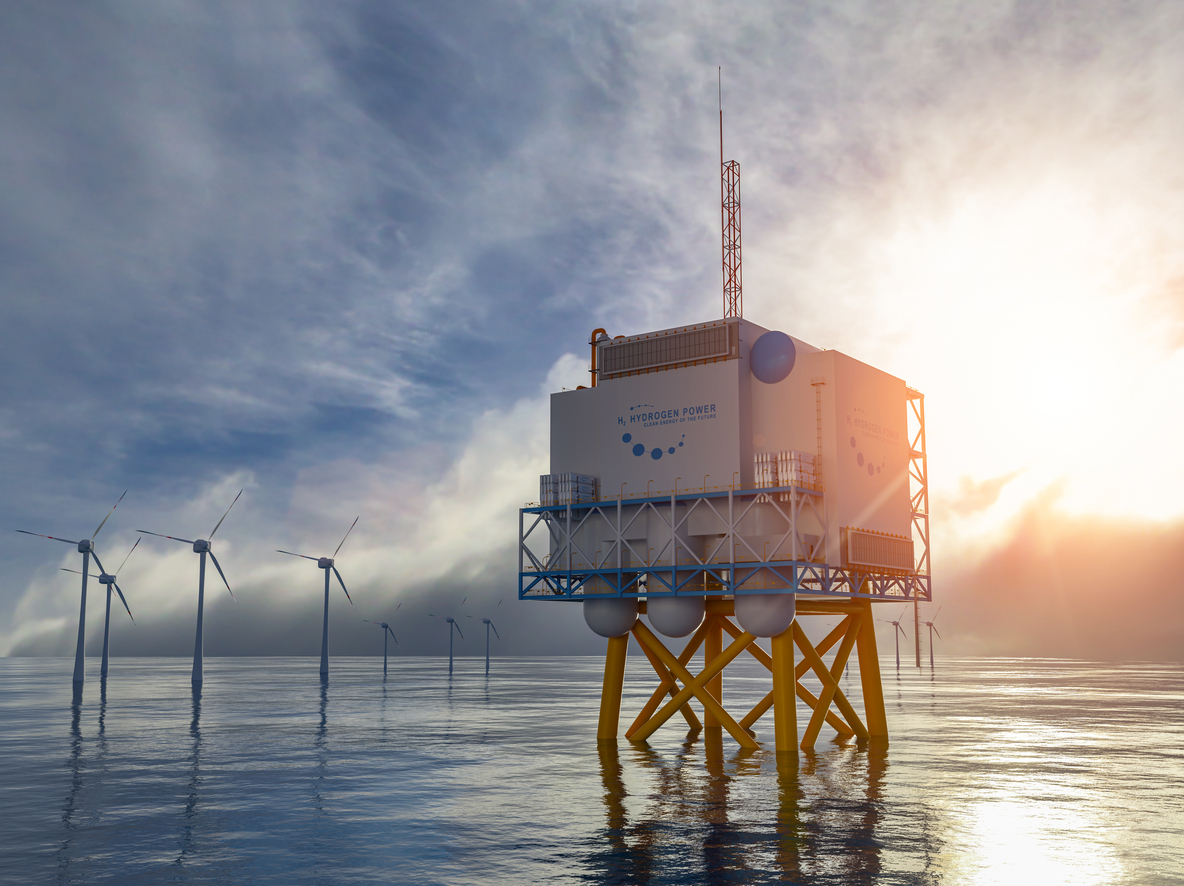
The one technological constant that ensures a level of continuance across the electricity generation and hydrogen production process is BESS. Having even short-duration energy storage provides valuable intermittency management for the site itself, while also providing ancillary grid stabilisation services, propping up the national supply and reducing prices during times of energy scarcity by transmitting to areas of higher demand. Added to the same site, hydrogen production facilities allow for electrolytic production during periods of surplus, cheap energy, while local heavy industrial businesses use the cheaper electricity until an increase in its price point brings the stored hydrogen reserves into action. In this way co-location can increase the amount of yield taken from the same amount of unconverted natural energy, as long as it is done efficiently. This is where there are further issues to tackle relating to technological advances, market developments, and regulatory blockages, which will be addressed in the next energyplains.co.uk post- but the possibility remains that local energy can be converted into longer-term storage solutions like BESS or hydrogen to bring businesses’ energy costs down while improving flexibility of supply to the wider energy market.
Shockingly, however, at this point in time only around 3MW of co-located BESS is in the ground. But steps are being made to address this. As a consequence, the early-stage status of this innovation, with all the risks it entails, is restricting the attractiveness of what are already fixed-capacity power plants that therefore have restrictive yields for their investors. The result is that more often this type of investment receives interest from mature-stage players like pension funds who seek long-term, consistent returns. This is a significant drawback slowing innovation in an early-stage, fixed yield investment. For co-location to be made more attractive it has to be complemented by further developments in grid reform and policy incentives so that industrial sponsors are more inclined to finance and organise construction in this area.
This would ensure that each stage in the plan of a co-location project’s development and operation is better adjusted to their target debt and equity providers. Getting involved in the riskier developmental stage of such projects necessitates such adaptation on the part of regulators, as only so much can be done in the private sphere. Although there is increasing exposure to infrastructural assets of late, on the whole when it comes to energy infrastructure the developmental and operational risks have to be reduced to an acceptable level so that capital providers do not seek better risk-return profiles from more flexible investments that perhaps don’t include tumultuous EPC and operational difficulties.
Such an approach to the planning system, grid reform, and other market incentives is required if there is to be a business case made for investing in these areas of high energy supply so that nation-wide energy consumers as well as local businesses can benefit. Many industries still alive in the UK today rely on cheap and easy access to large amounts of energy, with the cost reductions from not having to invest in individual transmission capabilities, coupled with BESS intermittency cost savings and hydrogen energy surplus, making proximity to co-located power plants a very significant bottom-line advantage to businesses of all sizes.
There are hurdles to ensuring that such developments can occur, however, not least of which being the way in which co-location is delivered on-site. This, as well as regulatory and grid constraints that are currently holding co-location back, will be covered in the next post on energyplains.co.uk.
Project outlook
Co-location of energy generation, BESS, and hydrogen production facilities: what are the advantages