
Flexibility in the energy sector relates to the ability for energy demand or supply to be changed depending on the situation across the relevant markets. Across Britain in 2023 around £57.6bn was spent on gas and electricity combined – with electricity accounting for £30.6bn. Investing in local adoption and national infrastructure that would enable full energy flexibility could save customers up to £16.7bn per year on their energy bills by 2050 – this can equate to 23% of household demand and a disproportionately higher share of spending on bills where demand reduction is timed effectively and the correct incentives are in place. This article explores how these conditions are being established and what more needs to be done.
The ENA worked on the standardisation of a model for DSOs to evaluate the amount and cost of flexibility services that would be worthwhile for their energy system. This model involves positioning a number of hours of flexibility provision required per annum. Many DSOs globally are acting on the benefits that flexibility infrastructure can bring as investment in this has been found to be more cost effective that the alternative of developing excess capacity at a margin that never requires flexibility to operate. This latter strategy is wasteful and does not represent as cost-effective a basis for building local energy systems. So the path to making flexibility pay for everyone lies in the development of business models that provide the data, the physical capability and the platforms that enable route to market for more assets that are capable of performing in the flexibility segment.
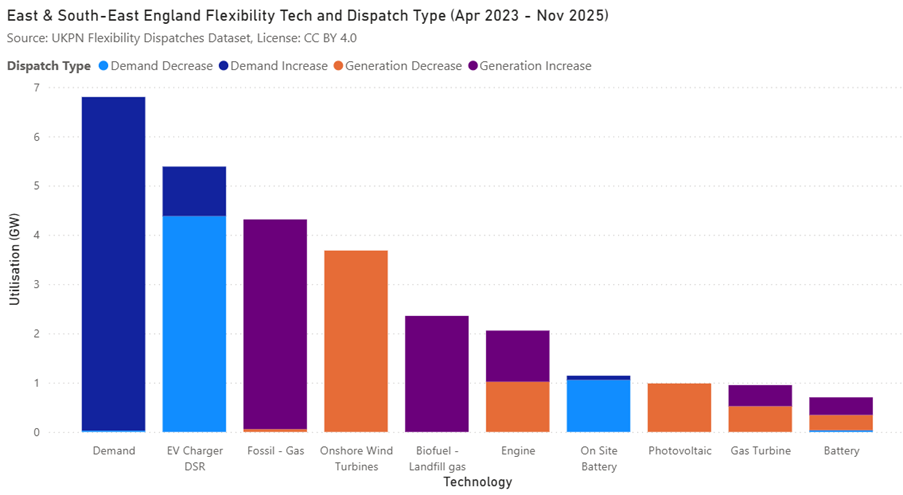
Looking at the UK’s flexibility capacity plan there is the potential for up to 40GW of flexibility to be procured from vehicle-to-grid charging alone by 2050, with 12GW total flexibility the target for 2030. To put this into perspective, the UK’s 2024 total electricity generation capacity installed was 73GW. Total consumer-led flexibility could peak at up to 75GW by 2050. Models predict that total electricity demand across the whole system may reach 250GW, so consumer flexibility levels equating to nearly 30% of this total is a highly significant prospect- although capacity utilisation rates may be fairly different as vehicles are not always available to contribute to grid flexibility. Different technologies contribute on different markets also, meaning that battery storage systems more prominently provide utility on national markets as opposed to those of regional distribution networks as shown in the graph below.
When combined with other flexibility technologies that are seeing enhanced installation rates recently, such as grid-scale battery energy storage, the extent of change to the market will be huge- with up to 50GW of commercially developed energy storage coming online by 2050 in addition to consumer-led flexibility.
The result of these developments for energy consumption is highly significant- shifting demand to less expensive periods throughout the day will mean that less reserve dispatch power is needed on the wholesale market, driving bid levels down as the most expensive generating assets operating in this segment are made redundant by flexibility assets reducing peak demand at the moments when it matters most. Even larger cost savings would come from network capacity investments foregone as a result of more effective use of existing resources, and uptake of otherwise curtailed electricity generation would mean that demand is more often meeting supply at the cheapest times.
The highest peak demand period across daily electricity markets comes at around 6-7pm. Electricity suppliers who can bring vehicle-to-grid flexibility services onto the distribution network en masse in this time slot are best placed to manage peak load effectively and therefore make the best margins for themselves, which translates positively to their customer offering. Introducing cheap household supply to public demand and lowering collective bills in the process of enabling flexibility rates to customers is a positive incentivisation for suppliers who were once more simply motivated to sell as much electricity to customers as possible.
The framework of opportunity
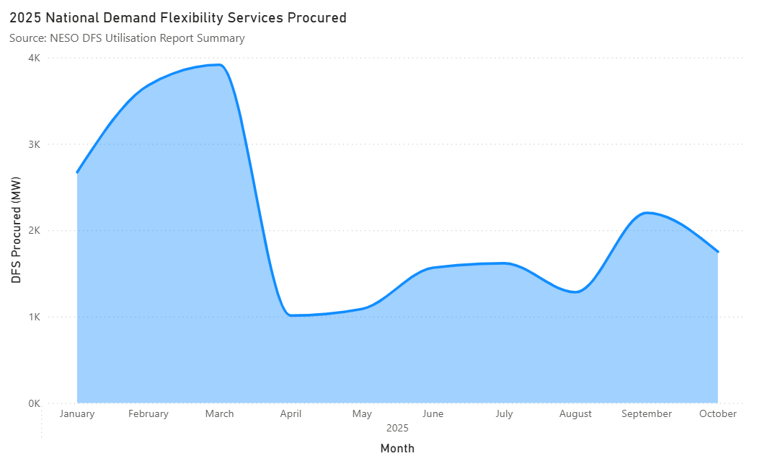
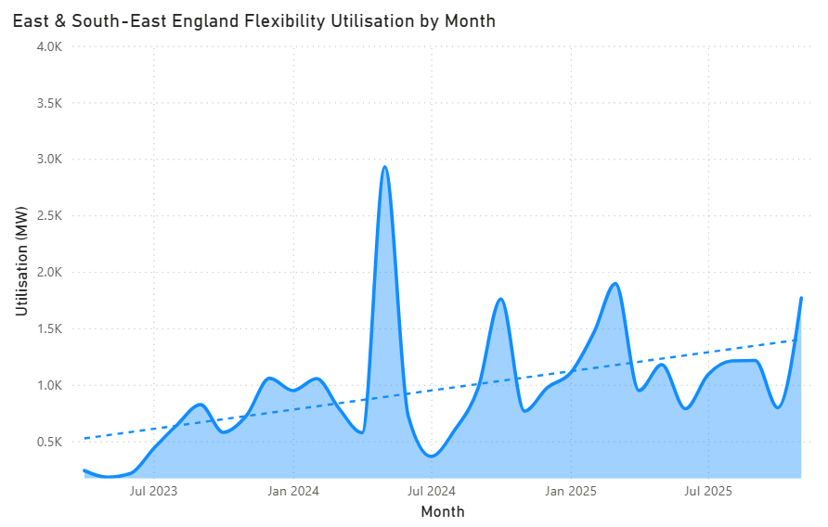
Local energy markets are where the majority of constraints exist, meaning that the best business case for smart grid solutions lies within the distribution network. This is shown by the first graph below indicating total national average transmission network flexibility procured coming out at between 1-3 GW per month, while the graph underneath shows only East & Southeast England flex utilisation consistently reaching comparable monthly levels by itself. It is within the distribution network that focused technological innovation has the potential to leverage some of the largest sources of energy demand/supply across the entire grid. Household and industrial consumption that utilises DER devices like EVs, batteries, and solar panels will be able to benefit from the integration of regional distribution markets with individual grid nodes so that savings and even earnings on electricity can be made – encouraging balancing of grid constraints by effectively harnessing distributed resources for what they are worth within a well orchestrated system.
Power markets developing toward providing positive financial signals for demand flexibility means that there are new ways for participants to leverage such systemic complexity. Grid-integrated customer tech offerings can provide various value propositions – some of the more effective approaches within the UK system of retrospective locational price signals would have to reflect this policy environment by providing incentives for demand and supply that align with the different distribution network cost periods, reflected in time bands. This can enable demand and supply shifting on a predictable and profitable footing depending on time of day and grid supply point location.
The common distribution charging methodology – used by DSOs to calculate how to charge consumption – utilises various indicators that suppliers can influence in order to offer lower rates to consumers on this basis. Along with the time band periods mentioned above, this includes likelihood factors of peak usage for different time periods, as well as coincidence factors relating a particular asset class’s (LV/HV) convergence around peak demand time among the group, and load factor – which is average load relative to maximum load across a year. Better enabling flexibility within the context of this charging methodology means that there can be ample reward for appropriately crafted flex participation.
Local Electricity Markets
As the power system grows there are market facets that suppliers will be racing to make the most out of. One of the more central changes that is taking place in Britain is the introduction of local electricity markets (LEM). LEMs are not yet active in any commercial context across the globe, but their premise is to rely on digitalisation of distribution networks as a means of more closely incorporating locational factors into distributed energy market participation. This would naturally change the market position of many flexibility assets that currently pay this charge into the system through relatively flat network rates, moving network charges for exporting electricity from the supplier bill to a different volumetric measure that is calculated at the interface of a collection of individual households with the wholesale market signals they participate in – arbitrated by a supplier/platform provider that aggregates supply and demand to create value on both sides.
This is different to the current model because energy suppliers up to this point do not offer such immersive participation and opportunity in the market to customers, generally instead being limited to predicting customer usage and offering general tariff rates to households, taking into account the rest of the customer base in the rates given to any single household. The notion of flexibility can mean that a customer benefits from reduced rates at certain times as provided by variable-rate tariffs like Economy 7. Excitingly and in addition to this, a more granular basis for providing flexibility will become available so that household locations that can benefit most from it will be able to take advantage of a more geographically tailored market offering.
In the meantime, the costs involved for bringing flexibility capabilities online in the context of a diverse mixture of existing assets can be large: including software platform development, license costs, liquidity index development, thermal efficiency upgrades, and of course, investment in the physical alteration of non-flex energy systems. This is not the only stumbling block in the process of developing these markets, however. Just as important as upfront costs is the approach that flexibility providers will have to take to make the capital costs for establishing LEMs worthwhile. This means that coordination between individual projects and public sector will have to be organised so a proper composition of assets that match the specificity requirements of a balanced, flexible market can be implemented. This is essential to ensure that the capability and proposition value for shifting load is really present.
Progressing market development
At this moment in time in Britain there are local flexibility markets hosted by platform provider Piclo, which enable providers to participate in flexibility markets, bolstered by the regulatory allowance of more participants. This participation can now occur through aggregators that trade >1MW of DER power on these markets. The next phase is to bring the work done on establishing these markets into the purview of local network balancing. Elexon becoming the flexibility services market facilitator has led to a roadmap for this area being developed and implemented, with market half-hourly settlement becoming mandatory in 2027, digitalisation being improved, and flex market barrier removal consequently moving forward to better enable revenue stacking across different markets as well as reductions in flex asset skip rates. Reducing these skip rates is one of the most essential aspects for making flexibility pay, as across Britain skip rates for batteries have reached 30% on national markets – meaning that if local markets are developed and better integrated with national counterparts such waste will occur less and less.
This is all essential if flex participation is to be embedded in customer offerings that create value for both the system and the customer. What this will enable is a system whereby instead of balancing the grid on national markets, the complexity of local networks can work in favour of supply imbalances by matching more economical options that may use distribution network infrastructure instead of that of the transmission network.
This has the effect of delivering balance to a grid from the bottom-up as opposed to the top-down market instrument of zonal/nodal pricing. Local markets and household energy tech solutions can also be developed within the latter’s system of top-down locational signals, but it would potentially be more complex to integrate household aggregations into nationally determined markets as opposed to separating distributed and ultra-high voltage/transmission-linked assets. This brings the flexibility potential of energy consumption to the doorstep- bypassing national markets and creating value within local distribution networks. This is where it is most needed and so this is where existing complexity can work in its own favour.